Characteristics of Japanese Industry
Japan is a nation known for its strong manufacturing sector.
According to the Economic Structure Survey of Manufacturing Establishments (excluding individually owned businesses), 15.9% of the total workforce was employed in manufacturing.
Although this share has gradually decreased since the period of rapid economic growth, it remains at a high level compared to other industries.
During the postwar high-growth era, Japan’s manufacturing was centered on heavy industries such as steel, shipbuilding, and petrochemicals.
However, after the oil crisis in the 1970s, the country improved its competitiveness through microelectronic technological innovation, developing machinery-based assembly industries as the core of its manufacturing strength.
Even today, the machinery industry remains the most globally competitive sector and continues to support Japan’s manufacturing base.
Industrial Composition
According to the 2023 Economic Structure Survey of Manufacturing Establishments, the composition ratio of manufacturing shipments in 2022 was as follows:
| Industry | ratio |
|---|---|
| Machinery Industry | 44.2% |
| Metal Industry | 15.0% |
| Chemical Industry | 14.7% |
| Food Industry | 11.7% |
Within the machinery industry, the automobile sector occupies an overwhelmingly large share.
Automobiles alone accounted for 19.5% of the total shipment value of all manufactured products.
Employment Composition by Industry
As of 2023, the distribution of employees by industry was:
| Industry | ratio |
|---|---|
| Machinery Industry | 42.5% |
| Food Industry | 15.9% |
| Metal Industry | 12.5% |
| Chemical Industry | 5.5% |
| Textile Industry | 4.4% |
This data reflects that machinery-related industries dominate Japan’s industrial labor structure.
Geographical Distribution of Industrial Zones and Regions
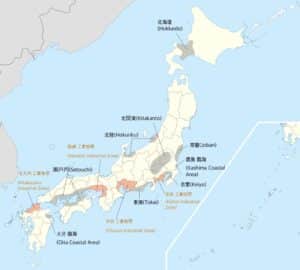
Japan’s major industrial areas are generally located along the Pacific coastal zone.
In particular, they form a continuous belt in the southern part of the Pacific coast known as the Pacific Belt.
These industrial zones along the coast had already been established before World War II, while additional industrial regions were developed after the war to take advantage of coastal accessibility and land reclamation.
| Industrial Zones | Industrial Regions |
|---|---|
| Keihin Industrial Zone | Kita-Kanto Industrial Region |
| Chukyo Industrial Zone | Tokai Industrial Region |
| Hanshin Industrial Zone | Setouchi Industrial Region |
| Kitakyushu Industrial Zone | Keiyo Industrial Region |
| Hokuriku Industrial Region |
Classification of Industrial Areas
In Japan, there is a clear distinction between “Industrial Zones” and “Industrial Regions”:
- The four major zones that existed before the war are referred to as industrial zones.
- The areas developed after the war are referred to as industrial regions.
This classification represents both historical development stages and geographical characteristics of Japan’s manufacturing structure.
Conclusion
Japan’s industrial geography forms a well-defined pattern that extends along the Pacific coast.
From the prewar industrial zones to the postwar industrial regions, Japan’s manufacturing evolved from heavy industry to advanced assembly-based production.
Even with global economic shifts, these zones and regions remain at the heart of Japan’s industrial and economic strength.